- YEAR VISITED:
- 2005 – Florence, Pisa, Pompei, Rome, Venice and Verona


Our 2005 summer vacation was our first experience traveling overseas. Before having kids my wife and I knew we wanted to travel internationally, but had no idea where to go. We saved, planned, and prepared… but took months deciding where to go. Our main hang up was the fact we are only fluent in English. The last thing we wanted to do was travel to a country where English was not the native language and then demand others speak English. No one wants to be “those people”. Therefore, we decided to take a guided tour and ultimately decided on Italy as our main destination. We selected a 10-day tour of Italy through the company Globus.

We arranged our own flight to Rome and then Globus took care of transportation, planned two meals a day, and provided a tour guide fluent in Italian and English. We stayed in Rome, toured Pisa, stayed in Florence, toured Pompei and Verona, and concluded our tour in Venice. It was a dream vacation in every way imaginable. I will never forget the feeling of excitement after landing in Rome and taking the 15-minute taxi ride to our hotel. It was surreal looking out the window of our taxi as we weaved in and out of traffic. Mopeds were everywhere, roads and cars seemed miniature, and driving through the Aurelian Wall (2,000 year old ancient wall that surrounds Rome) was like an out of body experience.


Upon reflection on our many travels and my insatiable sense of adventure, this was the exact moment I was infected by the proverbial ‘travel bug’.


———- ROME, ITALY ———-
EXPERIENCES: We began our tour of Rome at one of the 7-Wonders of the Modern World, the Colosseum. Our group was whisked right to the front of the line and we toured the inside of this historic location.


We learned it was built in the year 80 AD and is still today the largest amphitheater in the world. Additionally it hosted gladiator battles, re-enactments of famous battles, executions, and even mock sea battles. Besides taking the tour inside we also had free time to wander around outside.


The Arch of Constantine, built in the year 315 AD to commemorate a battle won by Emperor Constantine, is near the main entry.


Next, we headed to Vatican City and the headquarters of the Holy Roman Empire. Interestingly enough, while the Vatican is surrounded by Italy, technically Vatican City is it’s very own country.

We toured Saint Peter’s Basilica, which is absolutely massive. Highlights of the tour included seeing the papal altar, designed by Bernini. It was also surreal seeing Saint Peter’s throne as well as his tomb up close.


We then entered the famed Sistine Chapel. Sitting in this historic venue (which is used for Conclave and electing the new pope) and staring up at Michelangelo’s ceiling I became emotional. The combination of the chapel being such a holy location, with knowing I was in the same location as so many historical figures created a feeling that could only be described as ‘indescribable’. We were not allowed to take pictures so unfortunately all we have is a postcard picture.

Before leaving we explored Saint Peter’s Square. Over the years this is where the Pope has addressed hundreds of thousands of Catholics.


The Spanish Steps, the largest and widest staircase in all of Europe, connects the Piazza di Spagna (Square) to the Trinita dei Monti (Church).


The 135 steps have been the location for films, stories, various works of art and are considered to be a romantic location. The day we visited it was hot and humid and Jill was pregnant. As a result I carried her up the steps.


HOTEL / APARTMENT: Our travel group stayed at the 4-star Hotel Albani. It was located in downtown Rome and provided everything we could ask for. We did however get a kick out of just how small the shower was. Once I managed to squeeze in, which took some planning, it was all I could do to turn around to get wet.


RESTAURANTS: The Hard Rock Cafe has become a staple of our travels. This trend started in Rome as this was the first international Hard Rock Cafe I had ever eaten at. I guess it is fair to say it was ‘love at first sight’.


Throughout our trip, Globus provided two meals a day; breakfast at the hotel and then an Italian style dinner out. Besides experiencing some amazing Italian meals we got to know many of the other people we were traveling with. A few of our favorites were Karen (from Portland, ME) and Susan (from Boston).


ADVENTURE(S) AND/OR NOTABLE DESTINATIONS: The center of ancient Rome was known as the Forum. This was the meeting place, market place, and government residences all rolled up into one.


Today the Forum serves as a time capsule for tourists to get a glimpse of what life was like in the days of the Roman Empire. We took pictures of the Arch of Titus (built in 70 AD), the Temple of Antoninus (many of the blocks are over 2,000 years old), as well as the Temple of Julius Caesar (the location of his funeral).


In that same area is the Circus Maximus. Built in the 6th century BC, this was the first ever stadium built in Rome.


Historians waiver on it’s capacity, some say it could hold 150,000 thousand people and others say the number was closer to 300,000. What isn’t debatable is the fact it was the largest stadium in the world and held chariot races, military processions, and gladiator battles.


The Pantheon was built in 126 AD. Emperor Hadrian commissioned the building of the Roman Temple and today it serves as a Christian Church.

It is also the burial site for a handful of influential Italians, including Renaissance painter Raphael. Today (2013) it is visited annually by six million tourists.


The next historical site we visited was the massive Victor Emmanuel II Monument. King Emmanuel was the first King of unified Italy.


Construction was completed in 1935 and the monument is located in the Piazza Venezia (Venice Square). The square is a relatively modern area of town where multiple main roads meet. This balcony overlooking the square is where Italian Dictator, Benito Mussolini, declared war on Britain and France, thus bringing Italy into World War II. The infamous balcony is now simply known as Mussolini’s Balcony.


The Trevi Fountain, built in 1762, is the largest fountain in all of Rome. The fountain’s extremely detailed and ornate design is a reminder of Italy’s rich artistic history.


Following the release of Hollywood movie, Three Coins in the Fountain, a legend arose that throwing coins in the fountain will grant you certain wishes; 1-coin = you will return to Rome, 2-coins = you will fall in love with a beautiful Italian, and 3-coins = you will marry the Italian you met. We tossed one coin into the fountain, and hope to someday return.

———- PISA, ITALY ———-
EXPERIENCES: We spent an afternoon in Pisa exploring the Piazza dei Miracoli (Square of Miracles). The entire complex, which includes a Cathedral, Baptistry, Bell Tower (Leaning Tower), and the Camposanto Monumentale (Cemetery), is a UNESCO World Heritage Site. It is one of the most well preserved Medieval complexes anywhere in the world.


Prior to our visit I had of course heard of the Leaning Tower of Pisa, but had no idea why it was leaning or any of the history behind the complex. Upon our arrival I learned the tower was completed in 1372 and nearly immediately following it’s completion the tower began to lean. Multiple stabilization efforts have been conducted over the years. The most recent came in the 1990’s and took over a decade to complete. Engineer’s now estimate the Leaning Tower of Pisa will continue to be stabilized for at least the next 200 hundred years. We toured the grounds, entered the Cathedral and the Baptistry, but were unable to climb to the top of the Tower.


———- FLORENCE, ITALY ———-
The next stop on our tour of Italy was Florence. The city, really the entire region of Tuscany, is referred to as the “Birthplace of the Renaissance” and is famous for it’s art, sculptures, and architecture. Individuals such as Leonardo Da Vinci, Michelangelo, and Botticelli called Florence home during the 15th century, the height of the Renaissance. We spent three days exploring this historic location.


EXPERIENCES: The Ponte Vecchio Bridge was the first location we explored. Construction on the bridge was completed in 1346, it is the oldest stone bridge in Europe, and has the distinction of being the only bridge in Florence spared destruction during World War II.


Today the bridge, which is over 500-years old, is lined with stores and is bustling with tourists day and night. There are even a handful of apartments located on the bridge. We enjoyed casually wandering the bridge as well as up and down both banks of the Arno River.


The children’s story, “Adventures of Pinocchio” was created by Carlo Collodi who lived in Florence. Many of the settings for the stories are various locations throughout Florence, or in the nearby Tuscan countryside. Therefore, the community has become engrained with Pinocchio. Nearly everywhere we looked we saw references to the story; wooden puppets, books, and trinkets of all kinds with Pinocchio’s face of them. We brought home a miniature wooden Pinocchio Christmas ornament.

The Duomo Cathedral, or Cathedral of Santa Maria del Fiore, is one of the largest cathedrals in Europe. The Dome was designed by Renaissance giant, Fillipo Brunelleschi. Nearly anywhere you go in Florence you can see the glorious dome.


The Cathedral was completed in 1436 and is immaculate in everyway. The saying, “they don’t build ’em like they used to” has never been more true than when it comes to the Duomo Cathedral. When we were there the Dome was closed for construction. Unfortunately, that meant we did not get to experience the viewing platform at the top of the cathedral. We did however get a tour of the sanctuary and were able to admire the architecture inside and out.


HOTEL / APARTMENT: We stayed at Hotel Raffaello, a 4-star hotel in downtown. Truthfully, we did so much exploring we were barely ever in our room.

RESTAURANTS: While I don’t remember the names of any specific restaurants we visited, I do know we ate in Piazza della Signoria (Square of the Signoria). Every restaurant seemed to have outdoor tables. We selected one and enjoyed fantastic Italian food with our new friends. This is a first rate destination to people watch.


ADVENTURE(S) AND/OR NOTABLE DESTINATIONS: The Uffizi Galleries is home to some of the most prominent works of art anywhere in the world. Michelangelo’s stone “David”, Botticelli’s “The Birth of Venus”, and Da Vinci’s “Birth of the Magi” are a handful of the most famous works of art housed here.


Next to the Louvre in Paris, this is the most prominent art gallery anywhere in the world. The museum specializes in works of art from the Renaissance – the list of Italian artists that have their pieces displayed here is truly impressive. The David statue is definitely the top draw, so plan accordingly. We saw the famous statue, as well as walked for what felt like miles from hallway to hallway.


The gallery is adjacent to the Piazza della Signoria. There are multiple replicas of famous statues in and around the square for all to see. This is a popular location for people to congregate, shop, and eat. Because of so many tourists there was a large percentage of street performers. We got a kick out of watching some of their acts.


———- VERONA, ITALY ———-
We merely spent one day in Verona. However, that is all it took for us to absolutely fall in love with this charming medieval city. Someday we hope to return to Italy, and Verona is at the top of our list of places we would like to re-visit. We started our tour in Piazza Erbe (Old Town Verona), which dates back 2,000 years.


Verona is a city built on top of a city and as you walk through the square there are viewing decks designed to give you a glimpse of the ancient remains below. This combined with the medieval chains displayed throughout the square (which were used for public displays of torture) gave us the feeling we were traveling back in time. Verona was also our first experience with what is known as a “squat toilet”.


EXPERIENCES: The setting of William Shakespeare’s 14th century masterpiece, Romeo and Juliet, is said to be Verona. The “City of Love” is the location of the feuding Montague and Capulet families and is believed to be the inspiration for Shakespeare’s play.

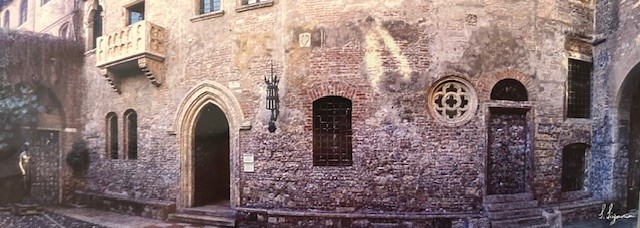
Juliet’s house, a 12th century brick home with a balcony facing a court yard, was the main attraction of our visit. Jill toured the house and paid to take pictures on the balcony. I stayed in the courtyard and re-enacted Romeo calling up to Juliet.


We also got a kick out of the Juliet statue in the courtyard. It was placed there in 1972 and it is rumored to bring “good luck in love” to all who rubs her breast. According to legend, we are now both lucky in love.


ADVENTURE(S) AND/OR NOTABLE DESTINATIONS: The Torre dei Lamberti is a tower in Verona that was built in the year 1172. We purchased tickets to the observation deck, which provided us with spectacular views of the entire city.


———- VENICE, ITALY ———-
Traveling to Venice was unlike anything I had ever experienced. Our tour bus offloaded at the Piazzale Roma, a large transportation center. From there we caught a water taxi and were transported to Venice. The city itself is built on a series of islands, over one hundred and twenty of them. The main street, or canal, is named the Grand Canal. The 15-minute water taxi ride from the Piazzale Roma, through the Grand Canal, and finally to our hotel is something I will never forget. Entering the “Floating City” was truly one of the most surreal moments of my life.


HOTEL / APARTMENT: We stayed at the Hotel Carlton on the Grand Canal. The building is over one hundred years old and it’s website advertises that it is “known for it’s Venetian style decor”. Far and away this is one of the nicest and most historic hotels we have ever stayed at. Plus, seeing as the hotel directly faces the Grand Canal, exiting the building and immediately seeing the magnificent canal made the whole experience a fairy tale.


EXPERIENCES: Piazza San Marco, or Saint Mark’s Square, is the center of Venice.


The square dates back to the 9th century. Exploring the square and walking on bricks that date back 1,000 years was magical. Everywhere we looked we saw pigeons. We purchased bird food and were instantly swarmed by pigeons. I enjoyed this phenomenon, my wife not so much.


The bell tower, on the edge of the square, is St. Mark’s Campanile. The original tower was over 1,000 years old. Unfortunately it collapsed in 1902 – what you see today is the rebuilt tower.


I purchased a ticket and climbed to the top. The tower is the highest point anywhere in Venice and the views were spectacular. While they warned me when I purchased the ticket, I was in the tower when the bells chimed. To this day the bells of St. Mark’s Campanile is one of the loudest noises I have ever experienced.


Saint Mark’s Basilica is also located in the square. The cathedral dates back to the year 931. Much of it’s ornate and gaudy decoration comes from treasure that was plundered from Constantinople during the Crusades. The ceiling tiles are made from gold, pearls, emeralds, sapphires, and rubies.


The Palazzo Ducale, or Doge’s Palace, is also located adjacent to the Piazzo San Marco. This former palace, government headquarters, and jail, is currently a museum. The architecture is known as Venetian Gothic and dates back a thousand years.


Marco Polo, a Venetian explorer who in the 13th century is said to have traveled around the world, was imprisoned here. Giacomo Casanova, known as the most famous lover in history, also spent time in a prison cell here.


The Bridge of Sighs connects the prison to the palace. Probably due to Casanova’s influence, a popular myth is that if a couple kisses while in a gondola passing under the Bridge of Sighs, they will enjoy eternal love. With Venice being built entirely on islands it should come as no surprise there are over four-hundred bridges. While the focal point is typically on the canals and traveling by boat, the city is an extraordinary place to walk.


The architecture of the buildings is unlike anywhere else I have been. Additionally, it felt like there was something new and interesting around every corner, and of course the canals and gondola traffic was fascinating to watch. We stopped to take pictures on the Ponte di Rialto and the Ponte degli Scalzi Bridges.


A gondola ride is an obvious must when in Venice. I can’t remember what we paid, but I know we had a 30 minute excursion through the Grand Canal as well as smaller side canals.

The entire experience is something I will never forget and something I feel incredibly lucky to have been able to experience with my wife.


ADVENTURE(S) AND/OR NOTABLE DESTINATIONS: One afternoon we took a 15-minute water taxi to the neighboring island of Murano. This island, home to roughly 4,000 Venetian’s, is known for it’s glass making.


We learned there is an art to glass making and this is where it originated a thousand years earlier. We had an in-depth glass blowing demonstration, which was fascinating, and then wandered the canals. Nearly every building was brightly colored, which gave me off a Caribbean island vibe. Murano is extremely photogenic and a great place to explore.


RESTAURANTS: While I don’t remember the specific restaurants we ate at, I just remember the food in Venice was some of the best we have ever eaten. Maybe even the best pasta and seafood I have ever experienced. Noodles, fish, clams, oysters, crab… you name it we ate it and it was prepared to perfection!
———- POMPEI, ITALY ———-

EXPERIENCES: The last city on our 2005 Italian itinerary was Pompei. It is located in Naples on the Amalfi Coast and the Tyrrhenian Sea in the shadow Mt. Vesuvius.


In the year 79 AD, Vesuvius erupted and the city was buried in lava, ash, and debris. For centuries the city remained buried, became slowly forgotten, and today has earned the nickname the “Lost City”. It wasn’t until the 18th century that the city began to slowly be excavated. Today Pompei is a popular tourist destination.


When we visited we walked through the streets, people’s homes, and various other ruins. Everywhere we went I felt as if I had traveled back in time as there were no modern amenities anywhere in the city.


The day we were there the heat was sweltering. The average high temperature for the months of July and August is 88 degrees – so pack lots of water and plan accordingly. I will never forget the bodies that were frozen in time by lava. It was heartbreaking, and fascinating at the same time, to see people exactly as they were on that fateful day in the year 79.


- OUR LIST TO VISIT OR RETURN TO:
- Cinque Terre
- Capri
- Lake Como
- An event at the Arena di Verona, Verona
 ‘Stros on the Road